SOUTH DOWNS ASTRONOMICAL SOCIETY

Welcome!


                  News:


Double Solar Flare Threat!

There is a chance of two simultaneous solar flares occurring over the next 48 Hours (30th April) One M-Class and one X- Class. Both have the power to cause widespread magnetic disturbance. This could be the first X-Class flare this year.

RECORD-SETTING ASTEROID FLYBY:

On Feb. 15th an asteroid about half the size of a football field flew past Earth closer than many man-made satellites.

 Since regular sky surveys began in the 1990s, astronomers have never seen an object so big come so close to our planet.

2013—A Happy New Year to all!

Thankfully (predictably) the world didn’t end. (Not in our particular quantum universe at least!). This won’t stop the doomsayers though, as there are plenty of big cosmic events happening in 2013. One of which is the expected arrival of comet ISON, which is expected to brighten to at least the brightness of the Full moon perhaps even being daylight visible –peaking from November onwards. However, as with all comets, the one thing we REALLY do know is they are not very predictable!


Sir Patrick Moore, CBE FRS FRAS 1923-2012

It is with deep sadness that the death of our society’s President, the astronomer Sir Patrick Moore, has been announced. He passed away peacefully at his home in Selsey at 12:25pm (9th of December 2012). No short passage of text can pay tribute to such a great man, suffice to say: cheers Patrick you will be greatly missed...


Pebbles Discovered on Mars!

Nasa’s curiosity Rover has discovered what appears to be an ancient dry river bed. It contains rounded pebbles, and calculations suggest water must have flowed for possibly many years. This is the first direct evidence for ancient stable liquid flowing water on the surface of mars.  Who knows—Maybe even then the Martian canal theory has mileage left in it yet!


Higgs Boson Discovered!

Cern have announced that they are ‘pretty sure’ they have detected the Higgs Boson (at the 4.9 Sigma confidence level.) This helps to further confirm the standard model of particle physics. It has massive implications for the search for Dark Matter Gravity and other exotic particles. Cosmology greatly relies on accurate particle and wave measurements so this new discovery will open the doors to a much better understanding of our universe. It’s scary what we still don’t know!

Transit of Venus!

6th of June 2012, at dawn, Venus will transit the sun, the event will already be underway as the sun comes  up. Lets hope for clear skies!


Aurora

Continuing Solar activity! Keep a lookout in the late northern night sky, somewhere very dark and away from light pollution is best. Already this year Aurora has been spotted in the UK on numerous occasions, (and some of us still remember the good old days when it was seen from a car park in Chichester!!)

Weald and Downland Open Air Museum summer exhibition was a success.

On Sunday 19th June 2011, we had a stall at the Open Air Museum at Singleton, West Sussex. Cloud appeared in the afternoon, but we managed to get some Solar observing in. Thanks to all who gave their support!

Meteorite fall in Poland!

A meteorite weighing 1kg has hit a house in Soltmony, Poland. It is thought to be an Ordinary Chondrite type meteorite.

Messenger enters orbit.

Nasa’s Messanger space craft has now entered orbit around Mercury. It has recently returned the first stunning images of the surface ever taken from orbit!

Click here for more info.

Continued Solar activity

There have been continued CME ejections this month, resulting in some spectacular auroras in Northern Latitudes.

Solar Activity hots up!!
Solar activity is now increasing as we head further into the next solar cycle. The first sightings of mid to low lattitude auroras of this cycle could occur over the next few  days due to a large CME stay alert. Keep an eye on spaceweather.com for further updates.

Eclipse!

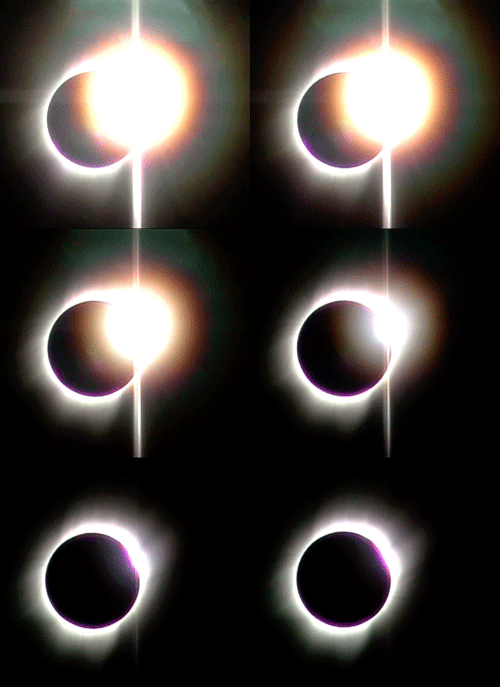
On the morning of the 4th January, Britain had a spectacular Solar eclipse. Unfortunately most of the UK was clouded out, but a few locations managed to glimpse the sight of a crescent sun appearing over the horizon!

Epoxi Nearing Comet Hartley-2

Nasa’s EPOXI mission is nearing comet Hartley2 in what promises to be a spectacular flyby. Multiple gas jets have been spotted, stay tuned for some stunning pictures in the days ahead. Click here for more info.


Sundog season!

There has been an increase in the number of Sundog sightings over the past few days. High altitude ice crystals have produced some spectacular optical effects.


Singleton Open Air Museum day a great success!

SDAS had a stall at Singleton Open Air Museum’s ‘Toy’s for the Boys’ day on Sunday 20th June. The event proved very successful and was well attended. We had a full day of solar observing with several telescopes as well as posters, meteorites and static astronomy equipment on display.

Massive Jupiter Impact!

There has been another cometry impact on Jupiter, it was captured on video by Christopher Go and can be seen here Well worth keeping an eye on Jupiter over the coming days as the resulting scar should rotate into view.

Solar Dynamics Observatory Up and Running

Nasa’s Solar Dynamics Observatory Satellite is up and running and is producing some stunning images and video of the Sun. Take a look here for more details.


Volcano Dust!

The volcano in Iceland grounded all UK aircraft in April, which was bad news for travellers, but great news for astronomers, as the lack of contrails resulted in a clear evening sky and good seeing. Stay alert for some spectacular sunsets, as the dust still continues to be pumped into the upper atmosphere.


New UK Space agency!?


You might be forgiven for thinking we have never had a space agency before, but actually we have always had one! However the latest incarnation  is now called ‘The UK Space Agency’.  It will have an operating turnover of around £230m a year, not enough to follow NASA but at least we will have a proper space policy focus in the UK.

Does this mean we will see ‘U.S.A’ on rockets in the near future??

Ice found on Moon!

The Chandrayaan-1 space craft  has found significant quantities of water Ice! Over 40 craters have been found to contain large amounts of frozen water. Water is important for life, and finding large reserves on the Moon means astronauts could be self sufficient, since water and lunar soil can be used to grow food, as well as providing hydrogen and oxygen for fuel.


Moon Landings Cancelled!

It had to happen at some point!, Nasa’s troubled Constellation program has been cancelled. Thus putting to an end Nasa’s planned human return to the Moon. (At least for now).
Faced with record borrowing, and a cynical public the US President Barrack Obama made the announcement on the 1st of Feb.

(One can’t help wondering where exactly they are planning on getting all the Helium3 fusion fuel they need from now? Courtesy of China perhaps?)


Happy New Year!

A very happy 2010! Science fiction fans will recognise 2010 as ‘The year we make contact’  let’s hope!

The ISS is truly spectacular

If you haven’t seen the ISS (International Space Station) then take a look.
See
Spaceweather.com for a chart showing times to look. It is truly spectacular in the evening sky!


Is the Sun waking up at last!?

After a long sleep during solar minimum it looks as if the sun is showing signs of becoming more active at last. The nature of  recent sun spot activity has boosted hopes that the new solar cycle is at last getting fully underway. Recently the sun has broken century long records for low sunspot activity, but the most recent sunspot has yielded many class C flares, and more sunspots look set to appear shortly. Fingers crossed!

Cosmic Rays reach highest levels in recorded history

The levels of cosmic rays measured by NASA spacecraft have reached an all time high. This is due to the deepest solar minimum in a century, and it has implications for astronaut safety and the reliability of space systems.

Keep an eye out for the International Space Station..

The international Space Station is extremely bright at the moment, due to Discovery docking a few days ago, well worth a look, check out  spaceweather.com for more details.

Jupiter has a new surface feature!
Jupiter has been struck by a large asteroid/comet fragment. Recent photos show the new  dark spot getting gradually bigger. It is not clear if this object is a stray fragment from the Shoemaker Levy comet (that impacted 15 years ago almost to the day), or an entirely separate object.

A Storm of meteorites may have made the early Earth, and Mars warmer and wetter.

A Bombardment of meteorites Early in Earth’s History may have tipped the balance in favour of life, research has shown.  Researchers analysed the water content from a certain type of 15 meteorite fragments from around the world and found that each fragment gave up 12% of its mass to water, and 6% as Carbon Dioxide, this has implications for Mars too, which may explain it’s suspected wet past.

So there you have it we may all own our very existence to the water content of  meteorites!


Dr Neil Bone -  1959-2009

It is with deep regret that I advise that Neil Bone president of the BAA Meteor Section, chemist, author, Astronomy Now writer and long time member of our society sadly died last week after a long illness.  Neil was one of the most inspiring people I have ever met, and among his great many achievements, had an asteroid named after him (A7102) in recognition of his considerable contribution to astronomy. How fitting that he left us right at the Lyrid meteor shower maximum, I am deeply thankful for all the inspiration he gave  to us all, and he will be very sadly missed.

 Our deepest thoughts go to his wife Gina and family.

Congratulations to Dr John Mason -MBE!

Dr John Mason has been awarded the MBE in the New Years Honors list, for services to Astronomy.

Jupiter’s core is twice as big as first thought!

Scientists at the university of California have recently modelled the core of Jupiter and discovered it must be twice as big as previously thought. The Rock densities are many times that of the earth surface, meaning that jupiter’s solid core is 14-18 times bigger than the earth! Whilst Jupiter is widely thought of as a gas giant, it is worth bearing in mind that it is actually also the biggest solid planet too!

Sagas website moved.

Sagas, the Southern Area Group of Astronomical Societies has moved it’s website to www.sagasonline.org.uk. The Southern Area Group of Astronomical Societies provides a forum where representatives of Astronomical Societies from the South of England can meet to share best practice and discuss items of mutual interest or concern. SAGAS also provides the conduit to and from the FAS Council via our FAS representative. Business meeting are usually held every 3 months near Chichester, Sussex.

South Downs Astronomical Society is a registered Charity No. 1052270)

Registered office is
46 Central Avenue,
Bognor Regis
West Sussex
PO21 5HH

Trustees P.E. FRAY, J.K.W GREEN MBE, Dr J.W. MASON and I.A.WOOD


Send us your astro pic
here